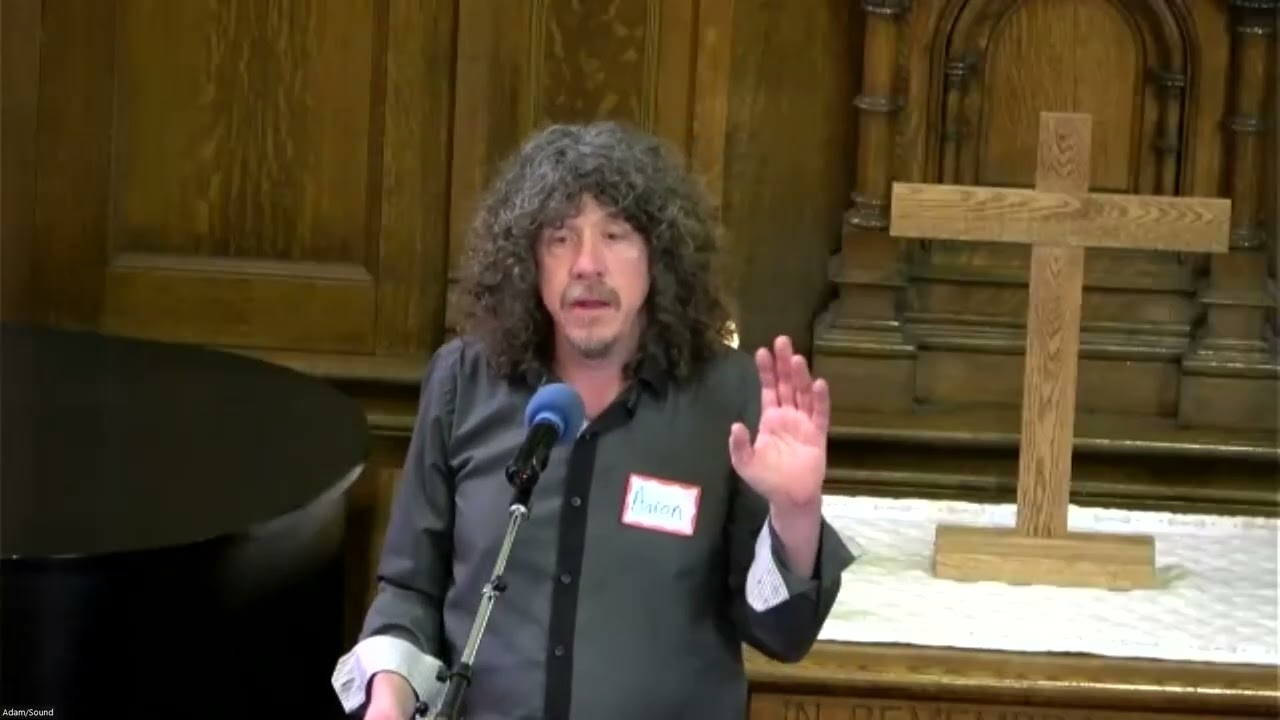
March 15 2026 Doug Holtby John 18 12 19 Politics, Power and Truth.mp3
So, we’re moving through the season of Lent, kind of inexorably toward Good Friday and Easter Sunday. By the way, we’re having a Good Friday service here, 10:30 in the morning, and we’re doing that with two other Strathcona churches, Strathcona Baptist and the Evangelical Fellowship Church. So, if you can come and be part of that, that’d be great. But, we’re letting the Gospel of John guide us as we move through this this story of the Holy Week and Jesus and his disciples, giving them a long bit of instruction and advice and comfort in the upper room and then moving into the Garden of Gethsemane and being arrested. This morning in our passage, we run through the various appearances, the trials that Jesus has to endure, and we come across three politicians, and we see their interactions with the savior. And we’ll find that each one of these politicians demonstrate they’re motivated by pretty low-level impulses of self-interest and self-motivation. Our savior demonstrates exactly the opposite. You know, shortly before the outbreak of the First World War, the German philosopher named Oswald Spengler, and he began writing a book that would be enormously influential, actually, an international bestseller entitled The Decline of the West. And during his writing of the book, of course, the the German military collapsed in 1918, and Spengler, being a German man, he descended into despair and cynicism regarding politics and morality and religion. And he said, “There are no eternal truths. Every philosophy is the expression of its own and only its own time. And the born statesman, and he means the the politician, the politician stands beyond true and false. He has convictions, certainly, that are dear to him, but he has them as a private person. No real politician ever felt himself tied to them when in action.” That’s pretty cynical when you consider that. There’s no eternal truths, any convictions that a politician might hold privately. He or she can’t possibly be expected to stick to them when push comes to shove and they’re acting in the mud and blood of uh the realities of politics. All three politicians in our passage, to varying degrees, they might have had some private convictions about things like truth and honesty and power, but each one feels compelled to set their convictions aside in their dealings with Jesus. Truth and power mean something very different to them than they do to him. And they feel they can’t possibly be expected to act with integrity when the situation demands otherwise. So, let’s look at these three politicians, their interactions with Jesus. He’s on trial first with the Jewish religious authorities, and then he is on trial with the civic ruler, Pontius Pilate, the Roman governor of Judea. So, after his arrest in the Garden of Gethsemane, we read in John 18:12, he’s brought before Jesus is brought before a man named Annas, and it says they bound him and brought him first to Annas, who was the father-in-law of Caiaphas, the high priest that year. Caiaphas was the one who had advised the Jews it’d be good if one man died for the people. A very brief history lesson, just to get these names straight. Annas had held the office of Jewish high priest from for 9 years, from AD 6 to AD 15, and then he had been pushed out of his office by the Roman governor at the time. However, though the job was no longer his, he had tremendous ongoing influence. Many Jews resented the fact that the Romans thought they could come and install a high priest and uninstall a high priest at will because uh according to the law of Moses, they anticipated that the high priesthood would be a lifetime appointment. It’s not something you would you would uh have to be elected for or have to serve just for a time. So, Annas remained the power behind the position. After him, no fewer than five of his own sons held the office of high priest, including his son-in-law Caiaphas. So, Annas is the family patriarch. He’s considered to be the real high priest, the power behind his son-in-law, who was the official Roman appointee. So, it’s no surprise that Jesus was taken to Annas first. Commentators on this passage often highlight the illegality of this procedure. It takes place at night, and Jesus, the accused, is being asked questions. Uh there’s no the the required questioning of witnesses is nowhere to be found. So, that was an omission that Jesus quickly pointed out. He said to Annas, “I’ve spoken openly to the world. I always taught in synagogues or at the temple, where all the Jews come together. I said nothing in secret. Why question me? Ask those who heard me. Surely they know what I said.” Jesus is really just saying, “Where are the eyewitnesses? What kind of trial is this? I don’t need to be questioned about things that I’ve said. Everything’s out in the open.” And instead of submitting to the high priest’s questioning, Jesus is questioning the procedural validity of what’s going on, and for that he receives a slap in the face. And the one who struck Jesus said, “Is this the way you answer the high priest?” And Jesus said, “If I said something wrong, testify as to what is wrong. But if I spoke the truth, why did you strike me?” So, as this Annas was assuming a position he no longer held, he was conducting an illegal investigation. It was an abuse of power, violation even of the Jewish law. So, following that brief appearance before Annas, we read that Annas sent him still bound to Caiaphas, the high priest, his son-in-law. Back in John chapter 11, after Jesus had raised his friend Lazarus from the dead, there was a meeting held among the religious Jewish leaders, where it was stated, “What are we accomplishing? Here’s this man performing many miraculous signs. If we let him go on like this, everyone will believe in him, then the Romans will come and take away both our place and our nation. So, they had no eyes to see. They had no impulse to worship or be in awe of Jesus. They had no way even to celebrate the fact that a fellow Jewish man had been raised from the dead and was now walking among them. All they were concerned about was self-preservation and hanging on to their jobs and their influence over the nation. Caiaphas agreed with them, but he took one things a step one step further when he said, “You know nothing at all. You don’t realize that it’s better for you that one man die for the people than that the whole nation perish.” So, now here was Jesus finally in Caiaphas’ clutches and his position as high priest, Caiaphas was supposed to be an intermediary between God and his people. Instead, his interests were solely that of a politician, perfectly willing to sacrifice the life of Jesus just for self-preservation. Václav Havel was a a Czech author. He was a poet. He was a playwright. He was an anti-Soviet uh political dissenter and he’d spent considerable time in prison as result of his activism. But, when the Soviet Union crumbled suddenly in 1989, this public artist uh this intellectual suddenly found himself, I believe he was plucked right out of prison and uh installed as the president of the United Czechoslovakia, later of the Czech Republic and he served until 2003. Havel was widely admired and respected and early in his political career in 1991, he received an award from the University of Copenhagen for his contribution to European civilization. Havel’s uh acceptance speech is remarkable if you read it. It’s one that we would wish that every one of our politicians would have the the courage to say. It deals with the temptations of political power. Havel notes that there are three types of motivations for people going into politics. One is because they really have better ideas about a better society and because they have faith, they have values and a desire to fight for those values and bring them to reality. A second motivation, he says, is the natural longing that people have for self-affirmation. He says, is it possible to imagine a more attractive way to affirm your own existence and importance than that that is offered by political power? In essence, it gives you tremendous opportunity to leave your mark in the broadest sense on your surroundings, to shape the world around you in your image, to enjoy the the respect that every political office almost automatically bestows upon the one who holds it. And a third motivation are all the benefits and perks that come with political office. You know, he was coming from a fairly shriveled Soviet system and he says many people long for political power because you get these all these benefits. And he he means things like salaries and you get a car and you get people to your cooking and your laundry and answer your phones and you have access to a private doctor or dentist. You don’t have to line up with the rest of people. All those little privileges and exceptions that come from holding political office. So, those three categories, spread your values and ideals, ensure your own self-affirmation, enjoy the perks of office. Havel said they’re they’re intertwined in complicated ways and at times it’s hard to tell which one of those is really driving you, which one predominates. He says he’s never met a politician who would admit that he was just in it for his own personal affirmation or for the perks of the office. He says we all say we we’re we’re noble and we care about our values and and promoting our values. It’s He says though at times only God himself knows whether that’s true or simply a more palatable way of justifying to the world and ourselves our longing for power, our need to affirm that we exist in a truly valid and respectable way. Pretty refreshing to hear a politician say something like that. And Havel goes on, he says, “You know, situation’s complicated because self-affirmation, it’s not That’s not just a reprehensible thing to want. I mean, to want to uh to to have some recognition, some affirmation is a fairly normal thing.” He says, “I’m one of those people who consider their term in political office as an expression of responsibility and duty toward the whole community, even,” he says, “as a sort of sacrifice.” But he says, “Observing other politicians whom I know very well, who make the same claim, I feel compelled again and again to examine my own motives and ask whether or not I’m beginning to deceive myself.” He says, “Am I really being driven by other things, by just the need for self-affirmation and all the little perks?” He says, “I’m I’m beginning to have suspicions about myself.” In fact, he says, “Every prize that’s given me,” and he was receiving a prize at the time he gave that acceptance speech. He says, “makes me more suspicious of myself.” He says, “There’s great understanding now of people who are uh being compromised by the treacherous and delusive, ambiguous temptation of politics.” He says, “You know You know uh he concludes, politics is a job for modest people, for people who cannot be deceived.” He says, “Those who claim that politics is a dirty business, they’re lying to us. Po- Politics is a work of a kind that requires especially pure people because it’s especially easy to become morally tainted. So easy, in fact, that a less vigilant spirit may not notice it’s happening at all.” Politics, therefore, ought to be carried out by people who are vigilant, sensitive to the ambiguous promise of self-affirmation that comes with it. And he’s very honest. He says, “I admit I have no idea whether I am such a person. I only know that I ought to be one because I’ve accepted this office. So, his suspicions about his political moves motives very revealing and leaves us, you know, if any of us have any kind of power at all or influence over other people, should constantly be suspicious of our own motives. Is self-affirmation our primary need? Is there something we’re hoping to get out of it? This morning we have this cautionary tale of Annas, his son-in-law Caiaphas, motivated very clearly by self-affirmation, preservation. They’ll throw away justice and they’ll execute an innocent man. They’ll sell out all their virtues that they ever held to. And we see that in their dealings with a third politician, the governor Pontius Pilate. This is a man who actually seems to have a little more integrity than either Annas or Caiaphas does, but he’s shown to be a failed politician in the end as well. Caiaphas needed Roman approval, Roman action to have Jesus executed. The Jews were limited in how far they could press capital cases. So, early Good Friday morning Caiaphas brought this roughed-up Jesus gates of Pilate’s palace and that’s where Caiaphas did everything he could to get in bed with secular power. Verse 29, a rather disinterested Pontius Pilate asked Caiaphas, “Well, what are the charges against this guy?” And Caiaphas tried to be a little cute. He said, “Oh, if he weren’t a criminal, we wouldn’t have handed him over to you.” But Pilate was having none of that and he told Caiaphas, “Just take him away, try him under your law by whatever for whatever misdemeanors he might have committed.” But the Jews objected and said chillingly, “But we have no right to execute anyone.” So, realizing that the Jews wanted to make this a capital case, Pilate then took Jesus inside for questioning, raised the subject of truth and a power. Wanted to confirm, “Jesus, are you are you really any threat to Rome?” He He “Are you king of the Jews?” And quite famously, Jesus really said, “Well, yes and no.” He said, “My kingdom is not of this world. If it were, my servants would fight to prevent my arrest by the Jews. But now, my kingdom is from another place.” “Oh, you are a king then?” said Pilate. Jesus answered, “You’re right in saying I’m a king.” So, in that brief exchange, Jesus says something I think hugely important about power and politics. He says he doesn’t want anyone ever drawing the sword or fighting or waging war in his name. His kingdom is not going to be moved forward by earthly power. No one should force their way politically and declare their government over their earthly territory to be a Christian government. Now, of course, for centuries uh the idea of a Christian nation was very prominent throughout Europe, throughout what is known as Christendom. You know, it’s it’s sometimes said that when the Roman Emperor Constantine, in the year 300 AD, he declared Christianity to be the official religion of the Roman Empire. Sometimes it’s said that he delivered Christianity from obscurity. He gave it its legitimacy. He gave it its power. That’s not really the story. All Constantine did was recognize the true power that Christianity already had. It had no political power to call its own. It was very much a minority religion. But Christianity become overly attractive in the Roman Empire, far more attractive than what was going on in its host culture. In his book, The Rise of Christianity, sociologist Rodney Stark writes, “Christianity revitalized life in Greco-Roman cities by providing new norms and new kinds of social relationships, able to cope with many of the urgent urban problems. To cities filled with the homeless and the impoverished, Christianity offered charity as well as hope. To cities filled with newcomers and strangers, Christianity offered an immediate basis for attachments. To cities filled with orphans and widows, Christianity provided a new and expanded sense of family. To cities torn by violent ethnic strife, Christianity offered a new basis for social solidarity. So, Christianity was not just a little spiritual movement. It brought with it a whole new culture, a way of looking at the world far superior to what was happening in the way the Romans ran things. So, the Christian approach to the poor, the Christian approach to marriage and sexuality, it’s so life-affirming that the Roman society around it slowly was becoming less brutal and a better place to live just because of the Christian the Christian influence. So, when the Emperor Constantine declared Christianity the religion of the empire, really he was just backing the winning horse. Jesus said, “My kingdom is not of this world.” But, Constantine thought that this Christianity so attractive, it really ought to be. And so, as the centuries unfolded, the European nations formed, Christianity was at their center and sometimes it was wonderful and sometimes it was awful. The church kind of loses its genius when it gets in bed with political power. It tries to mix politics and Christianity. And European Christendom often showed that to be a the sad case. There’s an African theologian named Lamin Sanneh and he’s often commented about the decline of European Christendom and the shift of Christianity’s global center to the global south. He says, “Christianity didn’t become a Western religion. The West just became Christian for a time.” In the future, people may say that the European experiment with Christendom did not work out very well. But, Christianity itself did not fail. It simply moved elsewhere. And he’s very right. In the year 1900, little over 80% of the world’s Christians lived in Europe or North America. Today, 2/3 of Christians live outside the Western world. Most dramatic growth has been in Africa, similar explosive growth of Christianity in Latin America and Asia. Historians who kind of track the geographical center of Christianity would say that in the year 1500, they would put a pin in the map uh and the the geographical center of Christianity would have been Spain. And in 1900, they would have put the pin in the map in northern Italy. Today, they would put the pin in the map showing the geographical center of Christianity somewhere around Chad in Central Africa. Jesus said, “I’m a king, but my kingdom’s not of this world.” There’s no place on Earth that can contain that kingdom of God. That’s why Christian nationalism was always such a weak endeavor. It’s always bound to fail. Columnist David Brooks writes that Christian nationalists practice a debauched form of their faith. Christian nationalism is it’s particular rather than universal. It’s about protecting us against them, the native versus the immigrant. It’s more about power than it is about love. It’s also more about threat than it is about hope. It’s rigid, pharisaical, and ra- rather than being personal and merciful. And yet, he adds on the other side of the coin, you have the exhausted remains of secular humanism. And the humanism started out trying to liberate people from dogma, but it’s just produced societies where people feel alienated and naked and alone. It failed to formulate a shared moral order so that people might find meaning and solidarity. He says, “It’s so enfeebled, it’s being replaced by the religion of the phone and just by shallow technological ways of living.” Brooks gets a little personal when he says that non-believers as well as believers often share the same spiritual longings. He himself says, “I’ve lived through decades of non-belief and now more than a decade of belief. In both phases, I ached for the transformation of the heart.” Because he was seeing that invisible, powerful kingdom of God, and he knew it had nothing to do with politics, nothing to do with nationalism. At one point, an exasperated Pontius Pilate, he was doing his best to set Jesus free. He said to his silent prisoner, “Do you refuse to speak to me? Don’t you realize I have power either to free you or to crucify you?” And Jesus answered, “Oh, you’d you’d have no power over me were it not given to you from above.” Bold words to say to a Roman governor. In other words, all human power eventually, ultimately flows in a Godward direction. All human power is delegated power. And even the vilest abuses of power on earth that we can think of, still not going to thwart the ultimate purposes of God, despite atrocious human behavior. And people are always held responsible for their actions. God remains in control. Jesus tells Pilate, “You’d have no power over me if it wasn’t given you from above.” Then adds, “Therefore, the one who handed me over to you is guilty of a greater sin.” He’s saying the political maneuvering of Annas and Caiaphas, they were very active sins, handing Jesus over to be judged and killed. And Jesus tells Pilate he’s he’s not saying you’re innocent, you know, this you have no role in your participation that that won’t leave you guilty, but his sin is somewhat mitigated because it’s more of the passive role. And when Jesus told Pilate that his kingdom was not of this world, Pilate said, “You are a king then?” Jesus answered, “You’re right in say saying I’m a king. In fact, for this reason I was born, for this reason I came into the world to testify to the truth. Everyone on the side of truth listens to me.” And at that, quite famously, Pilate said, maybe with a bit of a sneer, said, “What is truth?” As if to say to Jesus, I think, “Don’t you see this situation isn’t about truth, it’s about politics. Truth has nothing to do with it. I know you’re innocent. I know a case against you is full of holes. I know your accusers, they’re not being fair, they’re not being honest. I’m trying to use the power of my court to acquit you and to set you free. So, let’s not get into philosophy here. You don’t have the time for that and neither do I.” But the politics of the situation, it just unraveled the virtues of everyone involved. With Annas and Caiaphas, we see how quickly they’ll betray their true responsibilities, their assignments from God, if they think they can gain some advantage. They have their lieutenants work the crowd. Pilate offers a deal, a choice between freeing the true criminal Barabbas, or the innocent Jesus. And they play politics and they’re willing to cheer for Barabbas’ freedom and call for the crucifixion of Jesus. But their betrayal is really egregious, it’s really complete when they put Caesar above God. See, God is the true and the only king of Israel. Caiaphas and Annas, they know that, they believe that, their religion’s based on it. But Caiaphas and the crowd start shouting what amounted to a threat to Pilate. If this gets back to Rome, you’re done for. You can kiss your job and maybe your life goodbye. They say, “If you let this man go, you’re no friend of Caesar. Anyone who claims to be a king opposes Caesar.” Then Caiaphas and the religious leaders, they raise this false flag of patriotism. They utter severe blasphemy that none of them actually believe when they say, “We have no king but Caesar.” We have no king but Caesar. So, Caiaphas and and his ilk, they played nasty politics, their willingness to trade Barabbas for Jesus, to trade Caesar for God. And despite all their efforts to all his efforts to set Jesus free, in the end Pilate himself is a failed politician. Of him commentator Gary Burger concludes, “How often do the pilots of our world pursue a course of pragmatism and expediency, protecting their own self-interest, using the rhetoric of righteousness, feigning an interest in truth? But when backed into a corner, when pressed to make a decision with social consequences, they crumble.” “What is truth?” is the question you ask when truth is the last thing you want to hear. In the end, Pilate is of the world and represents a system that’s filled with darkness. He may intuit the light, as Pilate senses something’s wrong with his verdict, and he may make gestures toward truth, as when Pilate tries to free Jesus, but when the deal makers arrive, and when the pollsters report what it is that will secure the future, all commitments are tossed out like yesterday’s newspaper. Pilate killed Jesus. He did not have the resolve to act on what his instincts were telling him, that he found no basis for a charge against the man. So, when push came to shove, all the politicians in our passage, they threw truth to the curb in favor of their own interests. And our takeaway this morning from this passage about truth and power and politics and the plans of God, we see over and over again that people will act in their own self-interest. None of that’s ever going to thwart God’s purposes. Truth might be resisted, it might get pushed to the curb, but it’s still truth, and it might be ignored, but it can never be disposed of. Jesus said, “For this reason I was born. For this reason I came to the world to testify to the truth. Everyone on the side of truth listens to me.” So, it was truth that took Jesus to the cross, and the truth about us is that we’ve all offended God with our sin, and that the wages of sin is death, and that’s what we deserve. Yet, we have a savior who didn’t take up power. He just relinquished power. He kept letting it go just for our behalf. It’s not fantasy that we’re sinners. That’s not fiction. That’s not something someone dreamed up, but truth says that the innocent one who allows himself to go on trial and be condemned, when he dies on the cross in our place, if we listen to him, if we put our faith and trust in what he’s done, it puts us on the right side of truth. Annas and Caiaphas and Pilate, they all end up wound up on the wrong side of truth. Jesus says if we listen to him, we trust him, we’ll be on the right side of it. And politics and earthly power, it won’t matter much to us. In the mid- middle of World War I, November 30th, 1916, a number of European leaders still managed to get to Vienna, Austria for the funeral of the Emperor Franz Joseph I. You can watch clips of his elaborate funeral procession on YouTube. And that when that funeral procession arrived at the crypt, and this is where all the former emperors of the Austro- uh Austrian-Hungarian Empire were buried, there was this knocking ritual that took place. And before the emperor died, he knew this would happen. At the crypt, the herald knocked on the door, and from inside the abbot cried, “Who goes there?” And the answer was, “Well, it’s Franz Joseph, Emperor of Austria, King of Hungary.” Response from inside the crypt was, “I do not know you.” Again, the herald shouted, “I’m Franz Joseph, Emperor of Austria, King of Hungary, Bohemia, Galicia, Dalmatia, Grand Duke of Transylvania, Duke of” And again, the abbot from inside said, “We still don’t know who you are.” At that moment, the herald fell to his knees in front of all the assembly declared, “I’m Franz Joseph, a poor sinner humbly begging God’s mercy.” “Enter then,” the abbot said, and the gates opened. So, we can picture the face of any politician we know today and our our own faces reflected back to us in the mirror. No matter how much little power or influence we might accrue or how much affirmation we long to receive from people, we’re all going to be at the entrance of our own crypt one day and to enter we’ll all have to declare, “I’m a poor sinner. I’m just humbly begging for God’s mercy.” And if we do that, we’ll be on the right side of truth, we’ll have power figured out, and the door will swing open for us. So, let’s pray a little bit about this for the next couple moments and just couple things we can pray about is thank Jesus for showing us what truth and power really consist of. And pray that any power or influence that comes our way that is delegated to us from God, it’d be acknowledged as something given to us from above. And finally, we want to pray for some politicians that we would know, that they would have that kind of healthy self-suspicion of their own motives and their motives would become increasingly pure. I know that’s a big thing to pray for, but I think we ought to pray for our leaders those kinds of prayers. So, take a couple of moments of personal prayer and then I’ll close us off.