Feb 8 2026 DH John 17 1 5 Eternal Lifers.mp3
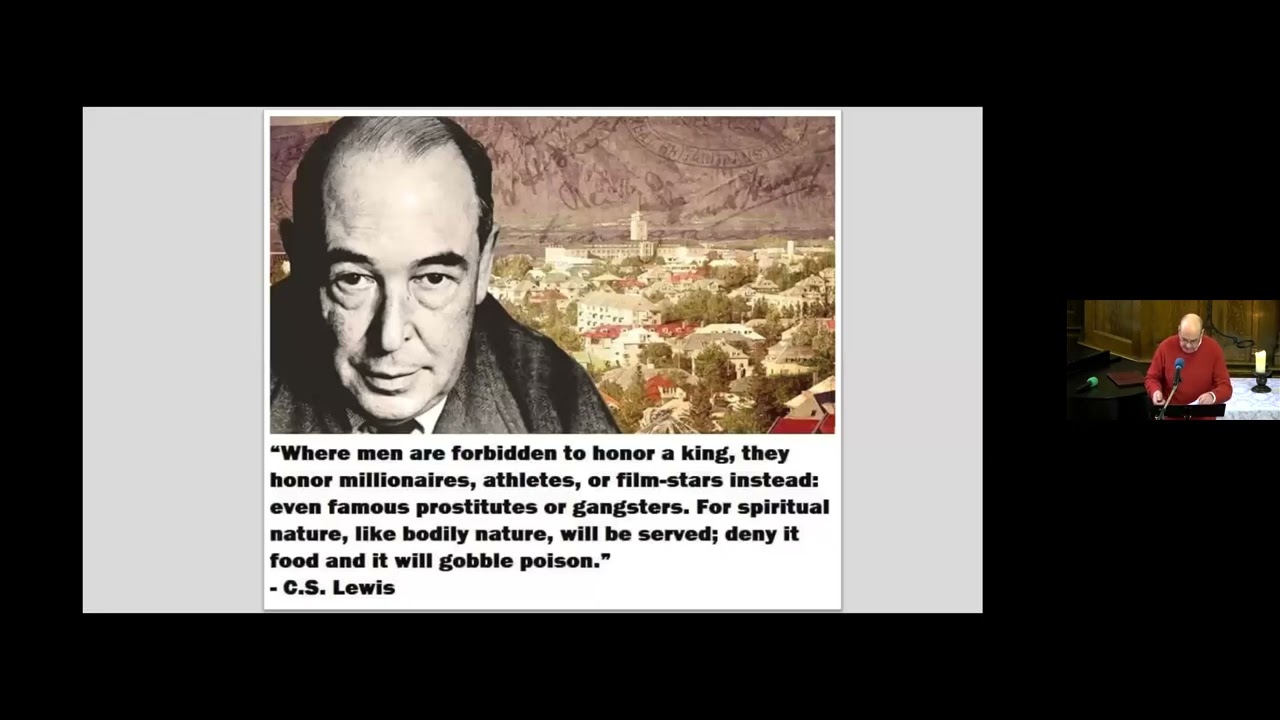
So, we’re going into pretty rich spiritual territory this morning with our passage because this is an entire chapter in the Gospel of John has nothing in it other than Jesus praying. And how spectacular is that? what we call the Lord’s prayer, the one that Jesus taught his disciples to pray in the sermon on the mount. That’s not a prayer that Jesus would ever have prayed because he would never have said to his father, uh, forgive us our trespasses, our sins, our debts because he had no trespasses and no sins and no debts of his own. His life was free from all that corrosion that uh that we find on our souls. So, if Jesus would never have prayed what we call the Lord’s Prayer, perhaps we should transfer that title to John chapter 17. And this is a prayer that Jesus actually prayed. And part of the brilliance of this chapter is that uh one of the ways, one of the key ways that we learn how to pray and deepen in our prayer lives is by praying with people who are more seasoned, mature believers than we are. You know, I I don’t think it’s a great habit to go around judging other people’s prayers, but prayer can be an indicator of just how far along we are in our trust and our friendship with God. If, especially when praying with others, if our prayers consist of just telling God a whole bunch of things that he already knows, we’re really just broadcasting the news to the people around us, we’re not really engaging with our father in heaven. And if our prayers are just given over to uh texting in our requests, our wish list, and there’s no praise, and there’s no adoration, no thanksgiving, no awe, no amazement, that also tells us something about uh how well we know the one we’re speaking to. So if we allow it, if we allow Jesus to uh give us a primer or a tutorial in the prayer that he prays, it can really help us in our prayer lives. And if you follow the flow of the chapter, it kind of goes like this. In the first section we’re looking at this morning, Jesus is just interacting with his father in heaven. It’s all about relationship. The relationship of Jesus with his father. He begins his prayer not looking around the room at the group of men. He will end up praying for them, but uh but not then. and he lifts his eyes up to heaven. Second portion of the prayer, he speaks um he he speaks to with his father about his followers. He wants to pray for the guys that he’s going to be leaving behind soon and the kind of mission and ministry that they’re going to have. And finally, at the end of the prayer, he prays for us, for all those who would come to believe through the message of the OG, the original disciples. And if we could ever have a look at our spiritual family tree for each one of us who are trusting in Jesus Christ for our salvation this morning, we could trace an unbroken chain back to those who communicated the gospel back to someone who was standing in Jerusalem on the day of Pentecost. That’d be fun to do. Maybe your chain begins with one of the giants, Matthew or James or Mary, the mother of Jesus or John, the gospel writer himself. Maybe your chain originates with uh the message Peter gave on Pentecost and he gave an invitation and 3,000 anonymous people responded and repented and put their faith in Christ. Maybe your chain traces back to one of those anonymous 3,000. But someone from Jerusalem that day, spoke to someone else, and eventually 2,000 years later, someone spoke the gospel to you. You repented. You placed your faith in Christ. And here you are today. In his prayer, Jesus anticipated that his disciples would reproduce, that the original disciples would make disciples, and those disciples would make disciples, and on and on it would go. So Jesus anticipated that really the core of what the church does is making disciples. And by the end of the chapter, then Jesus is praying all down the chain, every twig and branch in our spiritual family tree, and he’s praying for you and he’s praying for me. So spectacular piece of scripture we’re looking at. First five verses is all we’re taking in today. Jesus reveals and utters his his utter relational closeness with his heavenly father. No harm in reading it again. It just says Jesus looked toward heaven and prayed, “Father, the time has come. Glorify your son that your son may glorify you. For you granted him authority over all people that he might give eternal life to all those you’ve given him. Now this is eternal life that they may know you, the only true God and Jesus Christ whom you’ve sent. I brought you glory on earth by completing the work you gave me to do. And now, Father, glorify me in your presence with the glory I had with you before the world began. We’re going to ponder a couple things from this passage this morning. Brief passage. One, we better consider the word that’s repeated five times in five verses, and that’s the word glory. Let’s think about what glory means in Jesus prayer and what it means for us. And second, let’s dig into Jesus’ mission as he describes it. He’s the mission of bestowing eternal life on all those the father would give him on people like you and me. First glory and then eternal life. In his uh perception of glory, we see right away how different this prayer is from the prayer that Jesus would pray a few hours later in the garden of Gethsemane. That was an agonized prayer. Or that tortured prayer of abandonment that Jesus would pray on the cross the following day. We know that one. My God, my God, why have you forsaken me? It’s the only prayer of Jesus recorded in scripture where he doesn’t use the familial familiar name of father as he’s addressing uh God because on the cross Jesus felt cut off from his family from his father. Cut off so that you and I wouldn’t be cut off. But prior to that moment in John 17 in that warm fellowship of the upper room Jesus uh looked way beyond the misery of the next few hours and the agony of the following day and all Jesus could see was glory. Now, if you’ve ever had a day approaching that you you really weren’t looking forward to, it was going to press you beyond your comfort zone. It would be unpleasant. It would demand a lot from you, a meeting or an event you didn’t want to be part of, at an exam you didn’t want to take, and it was going to be confrontational or boring. You were going to have to take center stage and speak publicly or manage a lot of details. If I have a day like that facing me, usually I just tell myself, it’s okay. 24 hours from now, it’ll be over. This day is going to pass like every other day. the sun will come up tomorrow and I just have to get through these next few hours and I’ll be all right. And as Marvin would know, that that’s how every pastor feels on Sunday morning. Right. Right. Mark, not really. But Jesus likewise begins his prayer by peering beyond the cross into the eternal tomorrows into glory, saying to his father, “Glorify me in your presence with the glory I had with you before the world began.” In other words, Jesus is saying, “Let me put back on the clothes I wore before leaving heaven and coming down to earth. Let me be wrapped up again in my customary eternal splendor, and my father, let me shine again with you.” In Isaiah 42:8, it says, “Lord says, I will not give my glory to another.” God won’t share his glory with anyone because none of us deserve it. God has it all. God deserves the glory. any true glory that might come into our lives, it isn’t our own, but it is something reflected from the glory of God. So Paul in 2 Corinthians 3 can write, “Now the Lord is the spirit, and where the spirit of the Lord is, there’s freedom, and we who with unveiled faces all reflect the Lord’s glory, are being transformed into his likeness with everinccreasing glory, which comes from the Lord who is the spirit.” So any shininess in our lives and we might we might uh see that shininess in one another if we look around any shininess is not our own but it comes to us reflected from our father. You know I have a friend who owned a logging company in the interior of BC and he ran excavators and he was a young growing Christian and that’s the term he often used when he looked at other Christians. He just said they’re shiny. He saw something in in our faces and in our eyes that he didn’t see in his normal life. And he said that they’re shiny people. And if we had his insight and started looking around this morning at one another, you know, we might have to start wearing sunglasses to church because there is a reflected glory of God in our faces. It’s on us. And it says even we’re increasing. We’re going from glory to increasing glory as we go through our lives. There’s a lot of wattage in this room. if you if we actually had the eyes to see it. Now for Jesus, his shininess, that’s not a reflection. That’s his essence. He prays, “Father, glorify your son that your son may glorify you.” And when Jesus ascended to his father, it was nothing less than a reunification of the eternal Godhead in heaven. The father, the son, and the holy spirit. And that’s a trinity. We don’t understand that very well, but the Bible clearly teaches it. And in heaven, glory swirls around all three members of the Trinity. And there’s a mutuality of glory. There’s no competition for that glory. And this is pretty heady stuff, I know. So, let’s bring it down to earth and just learn what we can from this prayer of Jesus, how it might govern and inform our prayer lives. I think if there’s one way to put it, it would be that our number one purpose in prayer is not to get God to conform to our agenda, but to get our hearts in a posture where conforming to God’s agenda is really all we want. We recognize that when God is glorified, when in prayer we seek him to give him the glory, we can be pretty confident that what tumbles down from heaven into our lives will be for our greatest good. Whatever answers we receive, if our deepest desire is the glory of God, then we will receive any answers that come our way as representing our greatest good. So our purpose in prayer is not just to get things but to just find clarity and security, have our tanks filled up with the beauty and the glory and the goodness of the God we’re praying to. So there are riches available to us in prayer that go beyond the things we ask for. The Hebrew word term for glory in the Old Testament is cavode which conveys the idea of weight or heaviness or substance. To glorify something or someone is to give it a heaviness in our lives, a substantial weight. And one of the key benefits in prayer is that if we seek to give the weight and the substance and the glory to God, it has a way of reducing or removing all the lesser weights that are bogging down our lives. things that seem huge to us and put tons of pressure on us, they get reduced to to something manageable. Maybe not quite ounces, but something manageable when the weight and the glory of God in prayer is placed where it belongs on God the Father. So on the cross, Jesus voluntarily gave up his glory so that by trusting him, we could be brought into glory and then be transformed from one glory to another glory. Because Jesus lost his shininess on the cross to the point of even not being able to address God as his father, it opened up the path where the father’s glory, it wouldn’t be withheld from us, but God would actually begin to reflect it off our faces and off our words and our souls. So in prayer, I think beginning by warming up our hearts to the glory of God. That’s the very best thing we can do. And sometimes I do catch myself jumping right into my little shopping list of needs and requests, like mailing in an order. But over the years, I have kind of learned to catch myself and take a breath and just focus the beginning of a prayer time on worship and praise, adoration, the glory of God. Otherwise, prayer feels way too much like a retail transaction. It doesn’t much glorify God and probably in the end doesn’t do me a lot of good either. So that’s the glory piece in our passage this morning. And the glory piece forms a parenthesis around what Jesus says about eternal life, which is this. He says, “Father, again, the time has come. Glorify your son that your son may glorify you. For you granted him authority over all people that he might give eternal life to all those you have given him. Now this is eternal life that they may know you the only true God and Jesus Christ whom you have sent. The year 1916 uh midway through World War I there was a psychologist named James Luba. He was a devout atheist. He put out the results of a study he had done entitled the belief in God and immortality. And he he asked one a thousand randomly selected scientists if they believed in God. And he found that uh 41% of those scientists expressed disbelief in a personal god. Another 17% said they were agnostic. And along with disbelief in God came no belief in immortality and life after death in eternal life. He also found that graduating students from university were more likely to be non-religious than the incoming freshmen. And that suggested to him that there was a strong association between higher education and a decline in traditional Christian beliefs. So Luba’s theory was that as the modern world progressed, religious belief would continue to decline and die out and all and many people in the western uh academic intellectual elite were quick to agree with him. Luba study is not without its critics. Rodney Stark is a is a modern professor of sociology, comparative religion, and he said that the questions in the Luba survey are so narrowly phrased that it probably the results probably underestimate the extent of religious sentiment among scientists. And several recent more recent surveys of American college professors shows that the professors are pretty much as likely to express belief in God as the general American population as a whole. Luba’s study was actually repeated verbatim 80 years later in 1997 using his same narrowly phrased uh survey questions and the results were effectively unchanged. There had been no decline in religious belief among the scientific community. Religious belief in God was stubbornly stable. In Luba’s original survey, in addition to the question about belief in God, it also asked the respondents about belief in immortality, in eternal life. if and if if not if they didn’t believe it, would they even desire immortality anyway? And he found it puzzling and kind of inconsistent that 40% of the scientists said they believed in God, but even a higher figure, 50% said they believed in personal immortality. And many of the doubters who didn’t believe in God or immortality said that they really had a strong desire for immortality. They just didn’t know if they could get it. So even among those who don’t believe in God, the plausibility, the desiraability, the radical attractiveness of eternal life, it’s not going away. It’s not going anywhere. And how did that attraction get inside us? Why why can’t it seem to be extracted? The simplest answer is the one given in the book of Ecclesiastes 3:1 says that God has set eternity in the hearts of men. In other words, all of us unlike animals are were born pre-wired to both consider and to long for and to desire eternal life. And in Jesus’ prayer, he says that delivering eternal life, that was the main thing he came to do. He says, “Father, you’ve granted me authority over all people that I might give eternal life to all those you have given me.” says his his whole earthly career, everything he said, everything he did climaxes with that one great task of bestowing eternal life on those who the father would give him. So, Christianity as a as a term or description. It means a lot of things to a lot of different people. To some, Christian is simply a way of identifying a western nation, uh, European or North American. Those are Christian nations. and and to others, Christian is kind of synonymous with right-wing politics and nationalism. For many, the term Christian indicates maybe having an old-fashioned, non-progressive set of ethics. But what Jesus says here is that a Christian is not defined by any certain nationality or culture or value system. The root identity of what it means to be a Christian is to be an eternal lifer. It means being infused by Jesus with life. And we we all know that plants have a certain type of life and animals have a certain type of life and humans have a certain type of life. But Jesus adds here a fourth category of life infinitely higher, infinitely richer than plants or animals or earthly humans contain. Plants they they plants perceive a very small portion of reality. Might be able to sense temperature or moisture and incline itself toward that. Most of reality is completely lost on plant life. And animals, well, they have five senses like us. They can see and touch and taste and smell and hear. Generally aware of much more reality than plants, but but they can’t reason or philosophize or hope. They don’t really have awareness of beauty or ugliness or tragedy or sorrow or joy or right or wrong. They just don’t have the sensors to grasp a lot of the reality that we can. and earthly humans, we can degenerate into pretty animalistic beings. We can lose sight of things like justice and beauty and goodness and right and wrong. And we can disintegrate into people who just don’t have much self-control and who become what the Bible says are creatures of instinct. kind of a very unflattering picture of certain humans in in uh 2 Peter 2:12 talks about people who are bold and arrogant who slander celestial beings in the presence of the Lord and of such people it says but these men blaspheme in matters they do not understand they’re like brute beasts creatures of instinct born only to be caught and destroyed and like beasts they too will perish meaning that humans have the capacity capacity to degenerate into much lower life forms than were intended to be. You know, about the time of James Luba’s study in the early decades of the 20th century, people were almost merrily becoming those brute beasts that Peter writes about. First World War brought such a great disillusionment to the world. Author Joseph Lacante writes how young men set off for the front lines thinking they were headed for an adventure and a chance for heroism and distinction. Instead, the mighty armies of Europe, equipped with new weapons of destruction, resulted in collapsed empires, shattered economies, starved populations, refugees scattered across Europe. Nearly everything associated with the ideals and institutions of Western civilization, including traditional religion, was thrown into doubt. It was, after all, the liberal, Christian, enlightened nations of Europe that had engaged in what amounted to a mutual pact of suicide. In the aftermath of the war, uh the the arts, religion, all the old certainties and virtues, they seemed they seemed fluid. They seemed even obsolete. Poet TS Elliott wrote of Western civilization at that time as a heap of broken images. Description of a civilization in irreversible decline. Guy named JP Hoden. He saw a whole generation of artists of writers uh eager to sweep away all the old social, political and religious norms. while offering nothing of substance to replace them. He lamented everything sentimental and trivial was destroyed, but together with it everything that was vital. Walter Litman also observed that the artist of that time confronted the world without any accepted understanding of human life. He now has to improvise his own understanding of life. That’s a new thing in the experience of artists. And that was a hundred years ago when that was being said. And into that civilization vacuum marched all those diseased totalitarian efforts of the 20th century. Margaret Sanger came on with her eugenics and Stalin and Mao with their communism and Hitler and Mussolini with their fascism. Japan’s emperor worship their brutal military aggression. Every totalitarian ideology was left millions upon millions of corpses in their wake. Now, many of us here were we were born in that century, the 20th century, which in absolute numbers by far the bloodiest century of all time. As many as 200 million people died from two world wars and genocides and mass political killings and civil wars and revolutions, deliberate famines. There were new technologies, chemicals, nuclear bombs targeting not just soldiers but civilians and immensely scaled up the level of killing. And for the first time, governments killed off their own citizens in massive numbers. So those brute beasts that Peter wrote about were thoroughly released in the 20th century, demonstrating how anim animalistic humans can become, drifting into lower life, not moving into higher life. So when Jesus says we need eternal life infused in us, he’s saying that otherwise we’re in a kind of living walking state of death until he get we get what he has to offer us. And he tells us exactly what eternal life is. He says his mission is to give all those who his is to give it to all those who his father gives him. And then he adds this is eternal life that they may know you the only true God and Jesus Christ whom you have sent. He says, ‘You have to know the only one and true God. You can’t make it up as you go along. You can’t pick from a smorgas board of deities all sorts of false gods and false beliefs. People often might say, “Oh, I like to think when I think of God, I like to think of him like this or I like to think of him like that.” But Jesus is affirming here that if we want to know the only one and true God, part of that learning is very doctrinal. Knowing God, it’s it’s more certainly than doctrine, but it’s not less. The only and true God has given us his word, the scriptures, the doctrinal teachings of the apostles. So we can’t shun the doctrine and ever hope to really know God. Jesus says we have to come to know his father on his terms, not our own terms or eternal life is going to elude us. He also acknowledges in his prayer that to receive eternal life, you’ve got to know God one way and one way only through Jesus Christ whom God has sent. Jesus’ mission was to glorify his father to come to earth to die as a ransom payment for our sins and then bestow eternal life on all who would come to know God the father through him and make them make them eternal lifers and if he when he made them eternal lifers they’d have access to that reflected glory of God with the intent of making them shiny people in a dark world you know CS Lewis was one of those guys who recognized clearly the great widening chasm in the early part of the last century between those who were infused with eternal life and those who were be becoming more like brute beasts. He really saw the brute beasts uh up close and and personal when he was fighting on the front lines in World War I. And in the middle of World War II, another great 20th century conflict, illustrating the tremendous evil capacity in people, CS Lewis published his book aptly titled The Weight of Glory, saying that in light of the mass, the weight of God’s glory, every person you meet is becoming one of two things. It’s becoming an immortal horror or an everlasting splendor. So he wrote, “It’s a serious thing to live in in a society of possible gods and goddesses. To remember that the dullest, most uninteresting person you can talk to may one day be a creature which if you saw it now, you’d be strongly tempted to worship. Or else that person may be a horror and a corruption as such you only meet in nightmares.” And all day long, he says, we are in some degree helping each other to one or the other of those destinations, either an immortal horror or an everlasting splendor. So, we just want to take time to thank Jesus this morning for his g for the glory of God, for his bestowing of eternal life on us, for the the opportunity we have to reflect the glory of God to those around us. And we’re just going to take a few moments just to pray. This is your time with God. Then I’ll lead us in our prayer time this morning. But you might want to give to our father the glory due his name. Thank him that he allows his glory to be reflected in us. Thank Jesus that he has graciously and sacrificially given to us his eternal life. Pray also that you’ll grow not only as a disciple of Christ yourself but uh one who can make disciples of other people. So this is your prayer, your prayer time with God. And then I’ll lead us in our pastoral prayer.